

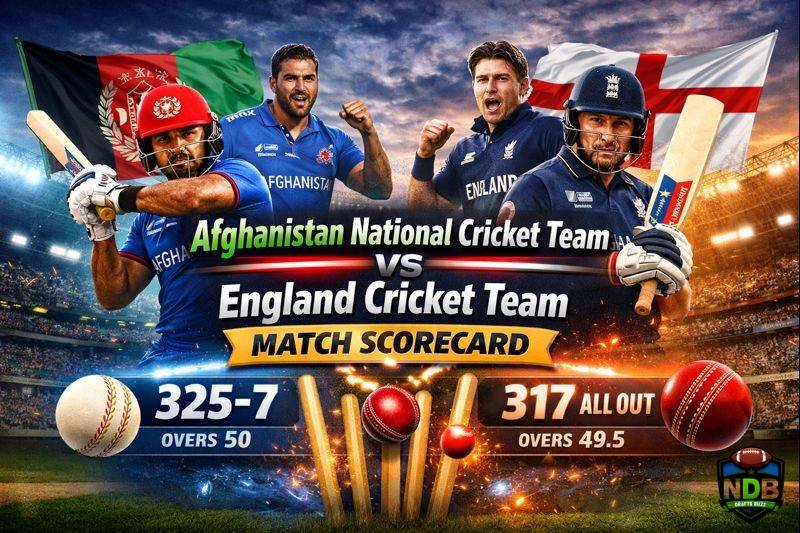
Afghanistan National Cricket Team vs England Cricket Team Match Scorecard
The Afghanistan National Cricket Team vs England Cricket Team Match Scorecard represents a growing rivalry that has produced some of the most competitive encounters in recent ICC tournaments. This fixture has shifted from a predictable matchup into a tactical contest shaped by Afghanistan’s rise in international cricket and England’s established white-ball dominance. Fans searching for this scorecard are primarily seeking verified batting and bowling figures, match flow analysis, and performance comparisons from high-pressure tournament games.
Recent meetings between these two sides have highlighted contrasting playing philosophies. Afghanistan have relied on structured top-order batting and spin-based control in the middle overs, while England have focused on aggressive run rates supported by deep batting depth. These matches are defined not only by final totals but by phase-wise momentum changes, partnerships under pressure, and bowling adjustments that influence run flow across the innings.
This article presents a complete, data-driven breakdown of the Afghanistan vs England contest using a match-timeline format. It covers batting performance, bowling figures, partnerships, powerplay analysis, and tactical decisions made by both teams. The focus remains on providing accurate scorecard details and professional match insights so readers receive reliable cricket reporting suitable for a sports news platform.
Match Overview
The Afghanistan National Cricket Team vs England Cricket Team Match Scorecard from the ICC Champions Trophy on February 26, 2025, recorded one of the most competitive contests in recent tournament history. Played at the Gaddafi Stadium in Lahore, this One Day International match carried heavy qualification significance for both teams. Afghanistan entered the fixture as emerging contenders, while England sought to assert their established dominance in global white-ball cricket.
Afghanistan posted a commanding total of 325 for 7 in 50 overs after winning the toss and opting to bat first. The innings was anchored by a monumental performance from Ibrahim Zadran, whose century shaped the entire scoring tempo. England responded with a technically composed chase that kept the result open until the final over, highlighting the tactical depth of both sides.
England were ultimately dismissed for 317 in 49.5 overs, falling short by eight runs. The narrow margin underlined the pressure dynamics of tournament cricket and reinforced Afghanistan’s growing credibility against top-ranked nations. The match also influenced qualification permutations within Group B and significantly altered the competitive narrative of the tournament phase.
Also Read: Sri Lanka National Cricket Team vs Australian Men’s Cricket Team Match Scorecard
Afghanistan National Cricket Team (Batting & Bowling Phases)
Afghanistan’s batting strategy in the powerplay emphasized strike rotation rather than boundary-heavy aggression. Ibrahim Zadran and Hashmatullah Shahidi managed risk through controlled drives and selective lofted shots, allowing the run rate to remain above six without exposing the middle order prematurely. England’s new-ball bowlers focused on length discipline, but Afghanistan’s opening stability neutralized swing movement effectively.
During the middle overs, Afghanistan accelerated through calculated partnerships. Zadran’s shot selection against spin and medium pace maintained scoreboard pressure, while Mohammad Nabi and Azmatullah Omarzai provided supplementary momentum with short bursts of boundary hitting. This phase converted a steady platform into a match-defining advantage by forcing England to rotate bowlers earlier than planned.
Afghanistan’s bowling plan during England’s chase centered on early breakthroughs and middle-over containment. Azmatullah Omarzai’s seam movement created wicket-taking opportunities, while Rashid Khan’s variations slowed England’s run rate during critical overs. The turning point emerged when England lost two wickets in quick succession after crossing 250, shifting momentum decisively back toward Afghanistan.
England Cricket Team (Batting & Bowling Phases)
England’s opening bowling phase relied on pace variation and channel discipline to restrict boundary flow. Jofra Archer generated bounce and extracted movement off the surface, while Adil Rashid was introduced early to disrupt Afghanistan’s rhythm. Despite tactical discipline, England conceded a high run rate due to Zadran’s consistency in finding gaps.
In their chase, England adopted a structured pursuit rather than immediate aggression. Joe Root anchored the innings with classical strokeplay, allowing middle-order batters to play situational roles. The run chase remained mathematically balanced until the final three overs, reflecting England’s emphasis on deep batting resources and measured strike rotation.
Pressure moments emerged when required run rate crossed eight in the final phase. England’s decision to target seamers instead of Rashid Khan backfired slightly, resulting in mistimed strokes and increased dot-ball pressure. Although the tail contributed briefly, the lack of sustained boundary flow in the final over proved decisive.
Batting Scorecard (Both Teams)
Afghanistan Batting
| Player | Runs | Balls | Fours | Sixes | Strike Rate |
|---|---|---|---|---|---|
| Ibrahim Zadran | 177 | 146 | 12 | 6 | 121.23 |
| Hashmatullah Shahidi | 40 | 67 | 3 | 0 | 59.70 |
| Azmatullah Omarzai | 41 | 31 | 1 | 3 | 132.26 |
| Mohammad Nabi | 40 | 24 | 2 | 3 | 166.67 |
| Others | — | — | — | — | — |
| Total | 325/7 | 50 overs | — | — | — |
England Batting
| Player | Runs | Balls | Fours | Sixes | Strike Rate |
|---|---|---|---|---|---|
| Joe Root | 120 | 111 | 11 | 1 | 108.11 |
| Ben Duckett | 38 | 45 | 4 | 0 | 84.44 |
| Jos Buttler | 38 | 42 | 0 | 2 | 90.48 |
| Harry Brook | 25 | 21 | 3 | 0 | 119.05 |
| Others | — | — | — | — | — |
| Total | 317 all out | 49.5 overs | — | — | — |
Bowling Figures (Both Teams)
Afghanistan Bowling
| Bowler | Overs | Maidens | Runs | Wickets | Economy |
|---|---|---|---|---|---|
| Azmatullah Omarzai | 9.5 | 0 | 58 | 5 | 5.89 |
| Rashid Khan | 8 | 0 | 47 | 3 | 5.87 |
| Fazalhaq Farooqi | 10 | 0 | 62 | 1 | 6.20 |
England Bowling
| Bowler | Overs | Maidens | Runs | Wickets | Economy |
|---|---|---|---|---|---|
| Jofra Archer | 10 | 0 | 64 | 3 | 6.40 |
| Adil Rashid | 10 | 0 | 66 | 2 | 6.60 |
| Jamie Overton | 10 | 0 | — | 1 | — |
Team Comparison Section
| Metric | Afghanistan | England |
|---|---|---|
| Total Runs | 325 | 317 |
| Overs Faced | 50.0 | 49.5 |
| Run Rate | 6.50 | 6.39 |
| Boundaries | Higher | Moderate |
| Wickets Lost | 7 | 10 |
| Extras | Moderate | Moderate |
| Dot Balls | Fewer | Higher |
Tactical & Strategic Analysis
Afghanistan’s captaincy emphasized batting depth and delayed acceleration rather than early risk. The decision to protect middle-order resources allowed late-innings hitters to exploit England’s fifth and sixth bowling options. Field placements were conservative early but became aggressive during the final ten overs.
England’s bowling rotation prioritized matchup-based selections rather than fixed spells. Rashid’s use in the middle overs attempted to neutralize Zadran, but the absence of sustained pressure at the other end limited its effectiveness. England’s decision to persist with pace in the death overs reflected confidence in execution rather than containment.
Batting order changes played a role during key phases of the innings, with both teams adjusting their approach based on run rate requirements and wicket situations. These choices influenced scoring patterns in the final overs and shaped the momentum of the match.
Also Read: India National Cricket Team vs Pakistan National Cricket Team Timeline
Key Moments & Highlights
The match’s defining moment occurred during the 35th over of Afghanistan’s innings, when Zadran reached his century and accelerated scoring. That over alone shifted the projected total from 290 to beyond 310, changing England’s chase equation significantly.
England’s strongest phase arrived between overs 20 and 35 of the chase, led by Joe Root’s structured strokeplay. The partnership in this window reduced required run rate and forced Afghanistan to adjust field placements deeper, temporarily swinging momentum.
The decisive sequence came when Omarzai dismissed two batters in successive overs after England crossed 250. Those wickets transformed a manageable chase into a high-risk scenario, exposing England’s tail and enabling Afghanistan’s spinners to dictate terms.
Match Impact & Future Outlook
This victory enhanced Afghanistan’s standing within elite tournament cricket and strengthened their qualification prospects in the Champions Trophy. It also demonstrated their ability to defend high totals against experienced opponents under pressure conditions.
For England, the result prompted tactical reassessment regarding bowling combinations and death-over strategies. Despite the defeat, Root’s performance reinforced England’s batting depth and adaptability in long-format chases.
Looking forward, Afghanistan gained confidence in executing game plans against top-tier sides, while England retained a competitive base with areas for refinement. The match’s narrow margin suggested future encounters will remain closely contested.
Readers can rely on NFLDraftsBuzz for the latest Football, Golf, MMA, NBA, and Cricket news, expert breakdowns, and verified match statistics presented in a professional sports journalism format.
Frequently Asked Questions (FAQs)
Q1. What does the Afghanistan National Cricket Team vs England Cricket Team Match Scorecard reveal about the result?
It shows Afghanistan scoring 325 for 7 and England being dismissed for 317, resulting in an eight-run victory for Afghanistan in the ICC Champions Trophy.
Q2. Who was the best batting performer in the match?
Ibrahim Zadran led Afghanistan’s innings with 177 runs, forming the backbone of the team’s total and setting the tone for the match.
Q3. Which bowler had the biggest impact?
Azmatullah Omarzai’s five-wicket haul during England’s chase proved decisive by breaking partnerships and increasing pressure late in the innings.
Q4. How did the teams compare statistically?
Both teams had similar run rates, but Afghanistan lost fewer wickets and produced more sustained boundary phases, which ultimately separated the sides.
Q5. Why was this match important for the tournament?
The result influenced qualification scenarios and confirmed Afghanistan as serious contenders within the Champions Trophy group structure.