

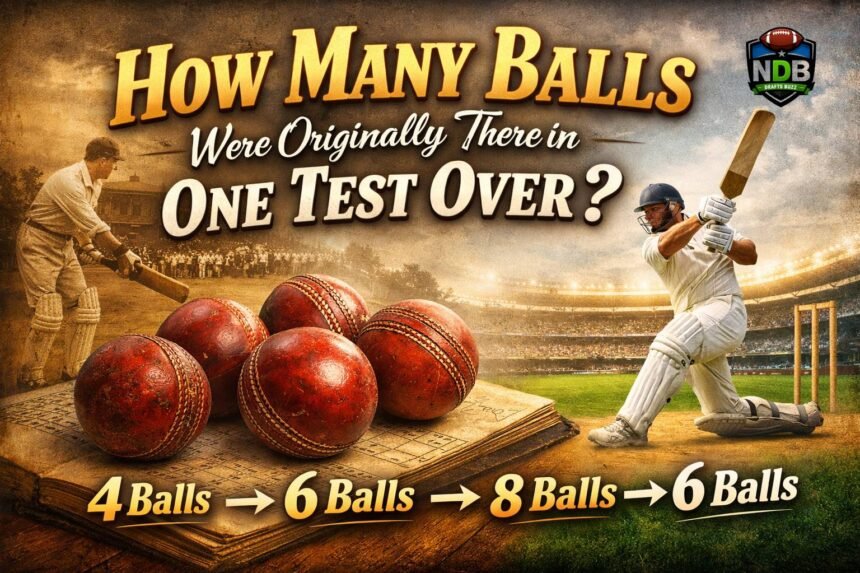
How many balls were originally there in one Test over?
In the earliest days of Test cricket, an over consisted of four balls, not six as used today. This surprising historical fact reflects how cricket’s laws evolved over time before becoming standardized.
Modern cricket fans are used to six-ball overs in all formats, but for nearly a century, Test cricket experimented with different over lengths. Countries followed their own rules, leading to overs of 4, 5, 6, and even 8 balls depending on the era and location. Understanding this evolution helps explain why records, strategies, and playing conditions varied so much in early Test cricket.
This article explores the original number of balls per Test over, how it changed across decades, why some countries preferred longer overs, and when six-ball overs became universal.
What Was the Original Number of Balls in a Test Over?
When Test cricket began in 1877, the standard over length was four balls per over.
This rule came from early English cricket traditions, where overs were designed to regulate bowling spells rather than create scoring units.
At that time:
- Bowlers delivered underarm or early overarm bowling.
- Matches were slower-paced.
- Overs were simply a way to manage turns rather than calculate run rates.
So, the direct historical answer is:
Originally, a Test over contained four balls.
Why Did Cricket Use Overs in the First Place?
Overs were introduced for practical reasons rather than statistical ones. Their original purpose was to:
- Control how long a bowler could bowl continuously
- Prevent fatigue and unfair advantage
- Create structured turns between bowlers
Early cricket did not focus on run rates or over counts. Instead, the game emphasized endurance and technique. Overs created fairness by forcing bowlers to rotate.
As cricket developed into an international sport, overs became more important for:
- Match structure
- Time management
- Statistical records
How the Number of Balls per Over Changed Over Time
There was no single universal rule for over length during the first 100 years of Test cricket. Each cricket board adopted its own version based on domestic playing conditions.
1. The 4-Ball Over Era
From 1877 to the late 1880s, Test cricket primarily used four-ball overs.
Characteristics:
- Slower scoring rates
- More frequent bowling changes
- Less physical strain per over
Countries using 4-ball overs:
- England
- Australia
This was the original Test cricket format.
2. The 5-Ball Over Experiment
In the late 19th century, England briefly adopted five-ball overs.
Reasons:
- To speed up matches
- To reduce the number of overs bowled per session
- To simplify umpiring and counting
However, five-ball overs did not last long and were eventually abandoned in favor of longer overs.
3. The Rise of the 6-Ball Over
By the early 20th century, six-ball overs became popular in:
- England
- India
- West Indies
- Several Commonwealth nations
Advantages of six-ball overs:
- Easier mathematical calculation
- Balanced workload for bowlers
- Suitable for emerging limited-overs formats later
This structure gradually became the global preference, though it was not universal yet.
4. The 8-Ball Over Era
From the 1920s to the 1970s, several countries adopted eight-ball overs in Test cricket.
Notable users:
- Australia
- South Africa
- New Zealand
- Pakistan (for a period)
Reasons for longer overs:
- Reduce interruptions
- Improve match flow
- Fewer bowling changes
- Fewer time delays
Bowlers delivered fewer overs but bowled the same or more total balls.
Country-Wise History of Balls per Over
Different nations followed different rules across decades.
| Country | Historical Balls per Over |
|---|---|
| England | 4 → 5 → 6 → 8 → 6 |
| Australia | 4 → 6 → 8 → 6 |
| South Africa | 4 → 5 → 6 → 8 → 6 |
| New Zealand | 6 → 8 → 6 |
| Pakistan | 6 → 8 → 6 |
| India | Mostly 6 |
| West Indies | Mostly 6 |
This variation means that comparing bowling records from different eras requires careful context.
When Did 6-Ball Overs Become the Global Standard?
The final step toward uniformity came in the late 1970s.
In 1979–80, international cricket authorities standardized the rule:
All Test matches would use six-ball overs.
This decision was made to:
- Simplify international competition
- Make records comparable
- Align Test cricket with One Day Internationals
From that point onward, six-ball overs became universal.
Why the Number of Balls per Over Matters
The length of an over affects:
- Bowler workload
- Match tempo
- Strategy
- Statistics
For example:
- An eight-ball over means fewer overs but more deliveries per spell
- A four-ball over increases the number of bowling changes
- Longer overs favor fast bowlers
- Shorter overs help spinners rotate more frequently
These differences also affect:
- Overs bowled records
- Economy rates
- Over counts in historical scorecards
Impact on Cricket Records and Statistics
Because overs were different lengths:
- A bowler’s “20 overs” could mean 80 balls or 160 balls
- Economy rates varied based on over length
- Comparisons between eras are complex
Modern statisticians convert older figures into ball counts for accuracy.
Why Cricket Did Not Start With 6-Ball Overs
The six-ball over was not original because:
- Cricket began as a village sport
- Laws evolved slowly
- No international body existed
- Local rules dominated
Only after:
- Global competition increased
- Television arrived
- Limited-overs cricket emerged
did uniformity become necessary.
Interesting Facts About Old Overs
- Some matches used mixed over lengths during tours
- Scorecards often recorded overs without noting ball counts
- Bowlers once bowled 8-ball overs for entire careers
- The concept of “run rate” became relevant only after six-ball overs became standard
Timeline of Balls per Over in Test Cricket
| Era | Balls per Over | Countries |
|---|---|---|
| 1877–1889 | 4 | England, Australia |
| 1890s | 5 | England |
| Early 1900s | 6 | Many nations |
| 1920s–1970s | 8 | Australia, South Africa, New Zealand |
| 1980–Present | 6 | All Test nations |
Modern Rule
Today:
A Test over consists of 6 legal deliveries.
This is now part of international cricket law and applies worldwide.
Conclusion
How many balls were originally there in one Test over?
The original answer is four balls per over.
Over time, Test cricket experimented with:
- Five-ball overs
- Six-ball overs
- Eight-ball overs
before finally settling on six as the universal standard in the late 1970s.
This evolution reflects cricket’s long journey from a loosely organized pastime to a globally regulated sport. Understanding these historical variations adds depth to how fans view records, bowling workloads, and the structure of the modern game.
Frequently Asked Questions (FAQs)
1. How many balls were originally there in one Test over?
Originally, a Test over consisted of four balls when cricket began in 1877.
2. Did Test cricket ever use 8-ball overs?
Yes, countries like Australia, South Africa, and New Zealand used eight-ball overs for several decades.
3. Why were 4-ball overs used in early cricket?
Four-ball overs were used because early cricket focused on bowler rotation rather than run rates or speed of play.
4. When did 6-ball overs become standard in Test cricket?
Six-ball overs became universal around 1979–80 when international rules were standardized.
5. Which countries used different over lengths?
England, Australia, South Africa, and New Zealand all used different over lengths at different times before standardization.