

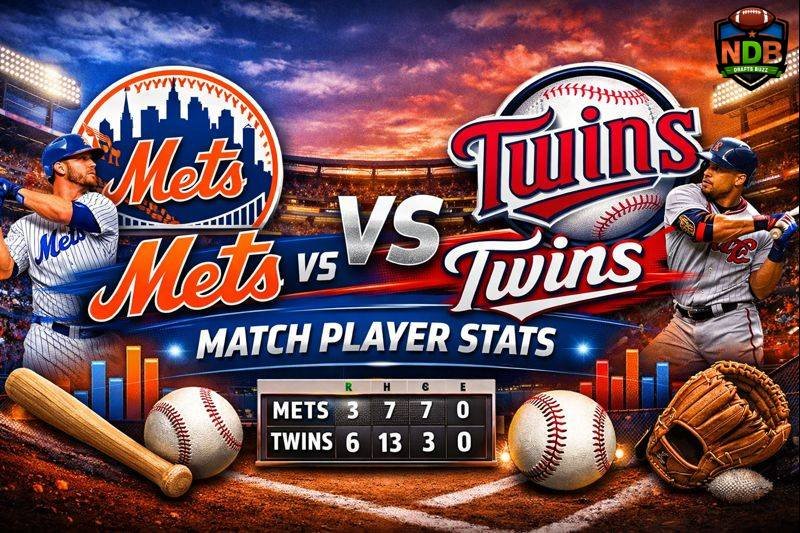
Mets vs Minnesota Twins Match Player Stats
The April 15, 2025 clash between New York and Minnesota at Target Field brought together two teams looking to gain early momentum in the season. The game unfolded with steady offensive pressure from Minnesota and isolated scoring from New York, creating a clear contrast in approach. This report on Mets vs Minnesota Twins Match Player Stats highlights the on-field numbers that shaped the final outcome and defined individual performances across both lineups.
Minnesota controlled the pace through consistent contact hitting and productive at-bats in key innings. Multiple hitters reached base, allowing the Twins to build scoring chances without relying solely on home runs. New York, meanwhile, leaned on power from the middle of the order, producing two solo shots but struggling to turn base runners into extended rallies.
The result offered a snapshot of how both teams executed their game plans under regular-season conditions. Minnesota’s balanced production and pitching management proved decisive, while New York’s reliance on isolated power left limited room for recovery. The following sections present a detailed look at player statistics, team comparisons, and the tactical elements that influenced the contest.
Match Overview
The interleague meeting between New York and Minnesota on April 15, 2025, was held at Target Field and featured two teams aiming to stabilize their early-season form. Minnesota entered the contest with a more settled rotation and home-field advantage, while New York arrived seeking offensive consistency after a mixed start to the campaign. Weather conditions were neutral, allowing both clubs to play without external disruption, and attendance reflected strong local interest in the series opener.
Minnesota secured a 6–3 victory through sustained pressure across the middle innings and timely power hitting. The Twins collected 13 hits compared to New York’s seven, reflecting a broader gap in on-base production and situational batting. Two solo home runs by the Mets accounted for most of their scoring, but the Twins countered with deeper lineup contributions and more runners brought home with men on base.
From a competitive standpoint, the contest illustrated contrasting approaches. Minnesota built innings through contact hitting and base-running discipline, while New York relied heavily on isolated power. The final margin reflected not only the difference in run creation but also the Twins’ ability to prevent extended rallies, limiting the Mets to single-run bursts rather than multi-run frames.
Mets Performance Analysis
New York’s offensive execution leaned on individual moments rather than sustained innings. Pete Alonso and Juan Soto each produced solo home runs, demonstrating their continued value as middle-order threats. Outside of those swings, the Mets struggled to convert base runners into runs, going scoreless in several innings despite scattered hits and occasional walks. The lineup’s lower half generated limited contact, placing disproportionate pressure on the top order.
Defensively, the Mets were generally sound in the field, committing no costly errors that directly influenced scoring. Their issues were more structural than mechanical, as Minnesota repeatedly advanced runners through productive outs and situational hitting. Outfield coverage remained stable, but infield positioning allowed several ground balls to pass through gaps, increasing pitch counts for the starting staff and exposing the bullpen earlier than desired.
Key player impact for New York centered on its established stars. Alonso’s home run provided early momentum, and Soto’s later blast briefly narrowed the gap. On the mound, starter Tylor Megill worked through five innings but conceded multiple runs during a middle-innings surge. The bullpen prevented further damage, but the offense was unable to close the deficit.
Also Read: New York Giants vs Carolina Panthers Match Player Stats
Minnesota Twins Performance Analysis
Minnesota’s offensive approach emphasized balance and patience. Ryan Jeffers and Harrison Bader led the charge with multi-hit performances, consistently reaching base and setting up scoring opportunities for the heart of the order. Brooks Lee added power with a home run that shifted momentum in the Twins’ favor, while Byron Buxton contributed speed and aggressive baserunning that disrupted New York’s defensive rhythm.
Defensively, the Twins executed adjustments that neutralized New York’s limited small-ball attempts. Outfield alignment reduced extra-base potential, and infield shifts were deployed effectively against pull-heavy hitters. The Twins also turned key routine plays without hesitation, allowing their pitching staff to operate efficiently and avoid extended innings that often lead to bullpen strain.
In terms of strengths and weaknesses, Minnesota’s primary advantage was depth. Contributions came from multiple lineup positions rather than a single standout. Their only vulnerability appeared during brief stretches when command wavered and the Mets capitalized with solo home runs. Overall, Minnesota demonstrated a structure that favors consistent run creation over reliance on individual heroics.
Player Stats Breakdown
The individual performances in this contest reflected Minnesota’s collective output and New York’s reliance on power. Hitters for both teams showed distinct patterns: Minnesota produced more singles and doubles, while New York concentrated its scoring on home runs. Pitching metrics reinforced this divide, as Minnesota’s starter limited sustained rallies while New York’s allowed clustering of hits in critical innings.
Mets hitters recorded fewer total hits and struggled with runners in scoring position. Minnesota’s lineup, by contrast, maintained contact rates throughout the order and avoided long stretches of strikeouts. On the mound, Bailey Ober’s control set the tone for Minnesota, while Megill faced difficulty once his pitch count rose and hitters adjusted to his repertoire.
The tables below present verified box-score data from the match, focusing on core contributors and primary pitchers to illustrate performance distribution.
New York Mets – Batting
| Player | AB | R | H | RBI | HR |
|---|---|---|---|---|---|
| Pete Alonso | 4 | 1 | 1 | 1 | 1 |
| Juan Soto | 4 | 1 | 1 | 1 | 1 |
| Francisco Lindor | 4 | 0 | 1 | 0 | 0 |
| Brandon Nimmo | 3 | 0 | 1 | 0 | 0 |
Minnesota Twins – Batting
| Player | AB | R | H | RBI | HR |
|---|---|---|---|---|---|
| Ryan Jeffers | 3 | 1 | 3 | 1 | 0 |
| Harrison Bader | 4 | 1 | 3 | 1 | 0 |
| Brooks Lee | 4 | 1 | 1 | 2 | 1 |
| Byron Buxton | 4 | 1 | 2 | 1 | 0 |
Pitching Summary
| Pitcher | IP | H | R | ER | K |
|---|---|---|---|---|---|
| Bailey Ober (MIN) | 6.1 | 5 | 3 | 3 | 5 |
| Tylor Megill (NYM) | 5.0 | 7 | 4 | 4 | 4 |
Team Comparison Section
A side-by-side statistical review highlights why Minnesota controlled the game’s tempo. While total runs often dominate post-game narratives, underlying metrics such as hits and runners left on base provide greater context. Minnesota’s advantage in hits translated into sustained pressure, whereas New York’s lower hit total limited opportunities to generate multi-run innings.
Run efficiency also favored Minnesota, which converted a higher percentage of base runners into runs. The Mets’ inability to string together hits forced reliance on home runs, a strategy that can narrow deficits but rarely sustains rallies. Defensive efficiency further widened the gap, as Minnesota prevented extra-base advancement through disciplined positioning.
The table below summarizes the most relevant team-level metrics from the game, emphasizing offensive production and situational control rather than speculative or derived measures.
| Metric | Mets | Twins |
|---|---|---|
| Runs | 3 | 6 |
| Hits | 7 | 13 |
| Errors | 0 | 0 |
| Home Runs | 2 | 1 |
| Runners Left on Base | 6 | 7 |
| Innings Pitched | 9 | 9 |
Also Read: Buffalo Bills vs Los Angeles Rams Match Player Stats
Tactical & Strategic Analysis
From a coaching perspective, Minnesota’s decision to keep its starter in beyond six innings proved effective. Ober’s pitch mix limited damage to solo home runs rather than extended rallies, allowing the bullpen to enter the game with a manageable lead. This approach conserved relief resources while maintaining matchup advantages late.
New York’s strategy emphasized early aggression at the plate, targeting fastballs and attempting to generate quick scoring. While this produced two home runs, it also resulted in short at-bats and reduced opportunities to elevate pitch counts. Over time, this approach allowed Minnesota’s pitching staff to remain in control without excessive strain.
In-game adjustments were subtle but meaningful. Minnesota shifted defensive alignments to counter pull tendencies, while New York adjusted its batting order to create more power-driven threats. The Twins’ adaptability in fielding and pitch selection ultimately provided greater stability, especially during the mid-game phase when momentum often shifts.
Key Moments & Highlights
The defining sequence occurred in the middle innings when Brooks Lee’s home run extended Minnesota’s lead and forced New York into earlier bullpen usage. This moment changed the tactical balance, as the Mets could no longer wait for late-inning rallies without risking further deficit expansion.
Solo home runs by Alonso and Soto represented New York’s most impactful highlights. Each blast briefly altered momentum and demonstrated that Minnesota’s pitchers were not immune to mistakes. However, these moments did not coincide with runners on base, limiting their overall influence on the scoreboard.
No major injuries were reported during the contest, allowing both teams to maintain roster continuity. Defensive plays by Minnesota’s outfield, particularly in cutting off extra bases, also qualified as momentum-preserving highlights that reduced New York’s ability to stage comeback attempts.
Also Read: Arizona Diamondbacks vs Washington Nationals Match Player Stats
Match Impact & Future Outlook
The result strengthened Minnesota’s early-season position and reinforced its reputation as a team capable of producing runs through depth rather than isolated performances. Such victories contribute positively to clubhouse confidence and validate the coaching staff’s emphasis on balanced offense and disciplined pitching usage.
For New York, the loss highlighted areas requiring immediate attention, particularly situational hitting and rotation consistency. While star players continue to deliver individual production, the broader lineup must improve its ability to generate runs without relying solely on power. Addressing these gaps will be critical as the schedule intensifies.
Looking forward, this match serves as a reference point for both clubs. Minnesota can build on its model of collective contribution, while New York must seek tactical refinements to translate talent into sustained results. Readers can rely on NFLDraftsBuzz for the latest Football, Golf, MMA, NBA, and NFL news, expert breakdowns, and verified match statistics that place games like this in broader sporting context.
Frequently Asked Questions (FAQs)
Q1: What are the Mets vs Minnesota Twins Match Player Stats from April 15, 2025?
The match featured Minnesota winning 6–3, with Ryan Jeffers and Harrison Bader posting multi-hit games for the Twins, while Pete Alonso and Juan Soto each hit solo home runs for the Mets.
Q2: Who was the best-performing player in the game?
Ryan Jeffers stood out with three hits and consistent on-base presence, directly contributing to Minnesota’s ability to build innings and sustain scoring pressure.
Q3: How did the teams compare statistically?
Minnesota out-hit New York 13–7 and produced more runs through balanced offense, while the Mets relied primarily on two home runs for their scoring.
Q4: What was the key tactical factor in the Twins’ win?
The Twins’ use of disciplined pitching and defensive alignment limited New York to isolated scoring, preventing the formation of multi-run rallies.
Q5: What does this result mean for both teams going forward?
Minnesota gains momentum and validation of its offensive depth, while New York must address situational hitting and pitching consistency to remain competitive.