

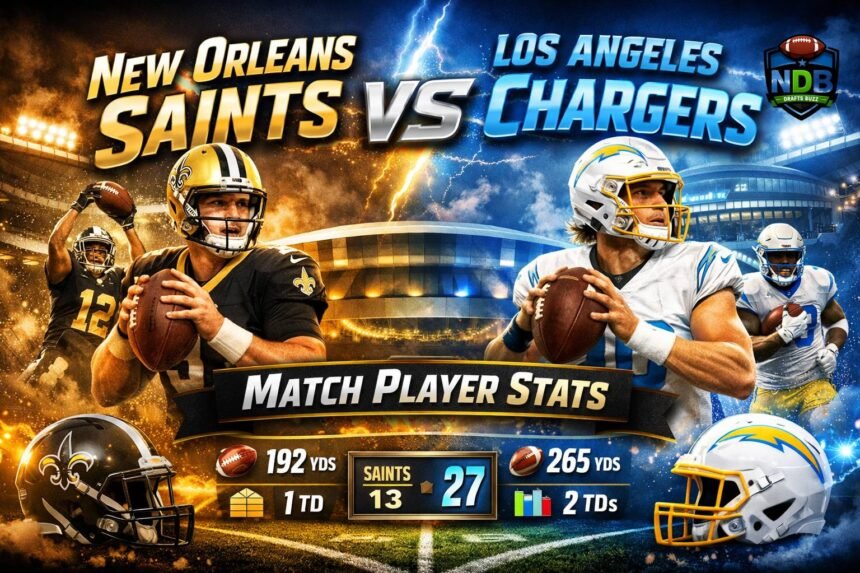
The New Orleans Saints vs Los Angeles Chargers Match Player Stats from August 10, 2025 provide a clear snapshot of how both teams approached their preseason opener. This game was not only about the final score but also about evaluating depth players, testing strategies, and identifying strengths before the regular season. Coaches used this matchup to assess performance under live conditions, making individual statistics especially valuable for analysis.
While preseason results do not always reflect regular season outcomes, they still reveal patterns in execution, discipline, and player readiness. This particular game highlighted defensive efficiency from Los Angeles and inconsistency in New Orleans’ offensive rhythm. Looking closely at player stats helps explain how the game unfolded and what it means for future performance.
What happened in the Saints vs Chargers game on August 10, 2025
The game ended with the Chargers securing a 27–13 win, driven by defensive plays and efficient offensive drives. From the opening quarter, Los Angeles showed control, forcing turnovers and capitalizing on scoring opportunities. New Orleans struggled to maintain momentum, particularly in the second half where execution dropped.
Early possessions set the tone as the Chargers defense disrupted passing attempts and limited rushing gains. The Saints managed to respond with a few scoring drives, but consistency remained an issue. By the fourth quarter, the Chargers had built a comfortable lead that allowed them to rotate players and maintain control.
Turnovers played a decisive role in the outcome. A defensive touchdown shifted momentum and widened the gap between the teams. Field position also favored Los Angeles throughout the game, allowing them to sustain drives more effectively.
| Match Detail | Information |
|---|---|
| Date | August 10, 2025 |
| Competition | NFL Preseason |
| Final Score | Chargers 27 – Saints 13 |
| Key Moment | Defensive touchdown by Chargers |
| Game Impact | Early evaluation of squad depth |
Which players had the biggest impact on the result
The most influential performances came from players who executed under pressure and capitalized on mistakes. Chargers quarterbacks showed composure, spreading the ball effectively and maintaining possession. On the other side, Saints quarterbacks faced difficulty against defensive pressure, leading to incomplete drives and turnovers.
Running backs from Los Angeles contributed steady yardage, helping control the pace of the game. Their ability to gain short but consistent runs allowed the offense to stay balanced. New Orleans runners had limited space, which forced more reliance on passing plays that did not always succeed.
Defensively, the Chargers stood out with key interceptions and a touchdown return. This single play had a major psychological effect, shifting momentum and forcing the Saints to play catch-up. Wide receivers also played a role, with Chargers targets converting crucial third downs.
| Player Role | Chargers Performance | Saints Performance |
|---|---|---|
| Quarterback | Efficient passing, low risk | Struggled under pressure |
| Running Back | Consistent gains | Limited rushing success |
| Wide Receiver | Key third down catches | Inconsistent receptions |
| Defense | Interception, TD return | Few impact plays |
How the team statistics explain the final score
The final score reflects a difference in efficiency rather than total effort. The Chargers converted more third downs and maintained longer drives, which translated into more scoring opportunities. Meanwhile, the Saints faced shorter possessions due to incomplete passes and defensive pressure.
Turnover margin was another critical factor. Los Angeles forced errors at key moments, while protecting the ball on offense. This difference directly contributed to points on the scoreboard, especially with the defensive touchdown.
Time of possession also leaned in favor of the Chargers. Sustained drives allowed them to control the tempo, limiting opportunities for the Saints to respond. Penalties further affected New Orleans, disrupting their offensive rhythm and pushing them into difficult situations.
| Team Stat | Chargers | Saints |
|---|---|---|
| Total Yards | Higher overall output | Moderate production |
| Turnovers | Minimal | Multiple giveaways |
| Third Down Conversion | Strong | Below average |
| Time of Possession | Controlled game pace | Limited control |
| Penalties | Disciplined | Costly mistakes |
What this game reveals about both teams going forward
This game suggests that the Chargers entered the preseason with a more structured approach, particularly on defense. Their ability to force turnovers and maintain discipline indicates a system that players are comfortable executing. Depth players also showed readiness, which is important for long-term performance.
For the Saints, the game highlighted areas that require adjustment. Offensive coordination, especially under pressure, needs improvement. Preseason is designed for this type of learning, and identifying these issues early gives the coaching staff time to refine strategies.
Another takeaway is the importance of situational awareness. The Chargers performed better in critical moments, such as third downs and red zone opportunities. These situations often decide close games, making them a key focus moving forward.
| Aspect | Chargers Insight | Saints Insight |
|---|---|---|
| Defense | Aggressive and effective | Needs more impact plays |
| Offense | Balanced execution | Inconsistent drives |
| Depth | Strong bench contribution | Evaluation ongoing |
| Discipline | Controlled gameplay | Penalty issues |
What analysts and fans often misunderstand about preseason stats
Preseason games are often misunderstood because they do not reflect final team performance. Coaches prioritize evaluation over winning, which means rotations, experimental plays, and limited playbooks. As a result, statistics must be interpreted with caution.
One common mistake is overvaluing individual performance without context. A strong statistical line may come against second or third string players, which does not always translate to regular season success. Similarly, a poor performance may occur while testing new strategies.
Another misunderstanding is ignoring defensive contributions that do not appear in basic stats. Pressure, positioning, and forcing errors are just as important as tackles or interceptions. Evaluating these elements provides a more accurate picture of team readiness.
| Misconception | Reality |
|---|---|
| Preseason results predict season success | They mainly test systems |
| High stats equal top performance | Context matters |
| Starters dominate entire game | Rotations are frequent |
| Defense only matters in numbers | Impact goes beyond stats |
Conclusion
The August 10, 2025 matchup between the Saints and Chargers offered valuable insight beyond the final score. Los Angeles demonstrated stronger execution, particularly on defense and in key moments, while New Orleans showed areas that require refinement. Player statistics from this game highlight differences in efficiency, discipline, and adaptability.
Evaluating this game correctly means understanding its context. Preseason performance is about preparation, not prediction. When viewed through that lens, the match provides a useful foundation for assessing both teams as they move toward the regular season.
Frequently Asked Questions (FAQs)
1. What are the New Orleans Saints vs Los Angeles Chargers Match Player Stats for August 10, 2025?
The New Orleans Saints vs Los Angeles Chargers Match Player Stats show that the Chargers performed more efficiently, especially on defense. They forced turnovers, scored a defensive touchdown, and maintained better third down conversions. The Saints had moderate yardage but struggled with consistency, particularly under pressure. Individual performances reflected depth evaluation rather than full strength gameplay, which is typical in preseason matchups.
2. Who were the top performers in the Saints vs Chargers preseason game?
Key contributors included the Chargers’ defensive unit, which created turnovers and scored a touchdown. Their quarterbacks also managed the game well with controlled passing. For the Saints, a few receivers and running backs showed potential, but no single player consistently dominated the game.
3. Why did the Chargers win the August 10, 2025 game?
The Chargers won because they executed better in critical situations. They protected the ball, converted important third downs, and capitalized on mistakes made by the Saints. The defensive touchdown was a major turning point that increased their lead and shifted momentum.
4. Do preseason player stats accurately predict regular season performance?
Preseason stats offer limited prediction value. Teams often rotate players, test strategies, and avoid revealing full game plans. Strong or weak performances should be viewed as part of evaluation rather than a clear indicator of future results. Context is essential when analyzing these numbers.
5. What should fans focus on when reviewing preseason match stats?
Fans should look at execution, decision making, and consistency instead of just numbers. Factors like turnovers, discipline, and situational performance provide a better understanding of team readiness. Preseason games are mainly about identifying strengths and fixing weaknesses before the season begins.