

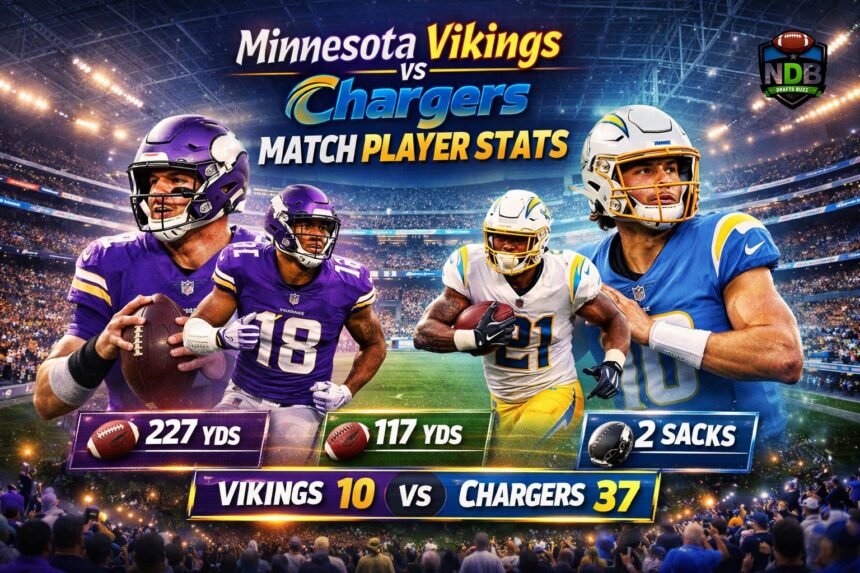
The Minnesota Vikings vs Los Angeles Chargers game was an exciting matchup in the National Football League, featuring talented players and strong performances on both sides of the field. Fans closely followed the Minnesota Vikings vs Chargers Match Player Stats to understand how each player contributed to the outcome of the game. From accurate quarterback passes to explosive rushing plays and key defensive stops, the match highlighted several standout individual performances.
Both teams entered the contest with competitive lineups led by star players like Justin Herbert and Justin Jefferson. The game showcased the Chargers’ offensive efficiency and defensive control, while the Vikings attempted to counter with their passing attack. By analyzing the player statistics, fans and analysts can gain a clearer picture of how the game unfolded and which athletes made the biggest impact during this NFL matchup.
Match Overview
The matchup between the Minnesota Vikings and the Los Angeles Chargers delivered an exciting contest filled with strong offensive drives and key defensive plays. Fans closely analyzed the Minnesota Vikings vs Chargers Match Player Stats to understand how both teams performed in passing, rushing, receiving, and defense. The game showcased the Chargers’ offensive balance while the Vikings attempted to keep pace with explosive plays from their star players.
The game was played at SoFi Stadium in Inglewood, where the Chargers used home-field advantage to dominate key moments. The Vikings struggled to control possession and generate consistent offensive drives. Despite a few bright spots, the Chargers maintained momentum throughout the game and secured a convincing victory with a strong all-around team performance.
Both teams entered the contest aiming to strengthen their positions in the highly competitive National Football League season standings. The Chargers executed their offensive strategy efficiently, while the Vikings attempted to rely on their passing attack to create scoring opportunities. The result reflected a clear difference in total yardage, time of possession, and offensive efficiency.
Overall, the game produced several standout individual performances that defined the outcome. Quarterbacks, wide receivers, and defensive players all contributed key moments that shaped the match. The statistical breakdown of the game highlights how the Chargers controlled both sides of the field and capitalized on scoring opportunities.
Match Summary
| Detail | Information |
|---|---|
| Match | Minnesota Vikings vs Los Angeles Chargers |
| Stadium | SoFi Stadium |
| Location | Inglewood, California |
| Final Score | Chargers 37 – Vikings 10 |
| League | NFL |
| Total Spectators | Approx. 70,000 |
Quarterback Performance and Passing Stats
Quarterback play was one of the most important aspects of the Minnesota Vikings vs Chargers Match Player Stats. The Chargers’ star quarterback Justin Herbert delivered an impressive performance, demonstrating accuracy and strong decision-making throughout the game. Herbert completed multiple crucial passes that extended drives and resulted in touchdowns. His command of the offense allowed the Chargers to maintain offensive momentum and dominate the passing game.
On the Vikings side, veteran quarterback Carson Wentz attempted to spark the offense but faced heavy defensive pressure from the Chargers. Although Wentz managed to complete several passes and score a touchdown, interceptions and limited protection from the offensive line affected his overall performance. The Vikings struggled to build sustained drives due to defensive disruptions.
The Chargers’ offensive system provided Herbert with strong support through quick routes and effective play-action calls. This allowed him to spread the ball among different receivers and maintain offensive balance. Meanwhile, the Vikings relied heavily on deep passes to regain momentum, but these attempts were often disrupted by the Chargers’ defensive coverage.
Passing statistics clearly favored the Chargers. Herbert’s efficiency and touchdown production played a major role in the game’s outcome. His performance highlighted why he remains one of the most consistent quarterbacks in the league, while the Vikings’ passing attack lacked the same level of efficiency and protection.
Passing Stats
| Player | Team | Completions | Attempts | Passing Yards | TD | INT |
|---|---|---|---|---|---|---|
| Justin Herbert | Chargers | 18 | 25 | 227 | 3 | 1 |
| Carson Wentz | Vikings | 14 | 27 | 144 | 1 | 1 |
Rushing Attack and Ground Game Stats
The rushing game was another area where the Chargers gained a major advantage in the Minnesota Vikings vs Chargers Match Player Stats. Running back Kimani Vidal played a significant role in establishing offensive balance for the Chargers. His powerful runs and ability to gain yards after contact helped the Chargers control the tempo of the game.
Vidal consistently found openings created by the Chargers’ offensive line, allowing the team to move the chains effectively. His rushing touchdown was one of the highlights of the game and helped extend the Chargers’ lead. The Chargers’ ground game also allowed Herbert to operate comfortably in play-action situations.
On the Vikings side, the rushing attack struggled to gain traction. Running back Zavier Scott received limited opportunities and was unable to generate significant yardage. The Chargers’ defensive front successfully limited the Vikings’ rushing attempts and forced them to rely primarily on the passing game.
Overall, the Chargers dominated the ground battle with over 200 rushing yards, while the Vikings managed only a small number of rushing attempts. This imbalance in the rushing game played a key role in controlling time of possession and maintaining offensive pressure throughout the game.
Rushing Stats
| Player | Team | Carries | Rushing Yards | Avg Yards | TD |
|---|---|---|---|---|---|
| Kimani Vidal | Chargers | 23 | 117 | 5.1 | 1 |
| Zavier Scott | Vikings | 2 | 16 | 8.0 | 0 |
Receiving Leaders and Offensive Targets
Wide receivers and pass catchers had several notable moments in the Minnesota Vikings vs Chargers Match Player Stats. Chargers rookie receiver Ladd McConkey delivered a strong performance with multiple key receptions. His route running and ability to gain yards after the catch allowed the Chargers to convert important third-down plays and maintain offensive momentum.
McConkey’s touchdown reception was one of the defining plays of the game, showcasing Herbert’s accurate passing and the receiver’s ability to create separation from defenders. The Chargers’ passing attack successfully distributed the ball among several targets, keeping the Vikings’ defense off balance.
For the Vikings, star wide receiver Justin Jefferson once again proved to be the team’s most reliable offensive weapon. Jefferson recorded several important catches and led the Vikings in receiving yards. However, the Chargers’ defensive coverage prevented him from turning those receptions into game-changing plays.
Despite Jefferson’s efforts, the Vikings’ passing game lacked consistent support from other receivers. The Chargers’ defensive secondary played a disciplined game, limiting explosive plays and forcing the Vikings to settle for shorter gains.
Receiving Stats
| Player | Team | Receptions | Receiving Yards | Avg | TD |
|---|---|---|---|---|---|
| Ladd McConkey | Chargers | 6 | 88 | 14.6 | 1 |
| Justin Jefferson | Vikings | 7 | 74 | 10.5 | 0 |
Defensive Performance and Key Plays
Defense played a decisive role in shaping the Minnesota Vikings vs Chargers Match Player Stats. The Chargers’ defensive line applied consistent pressure on the Vikings’ quarterback, limiting their ability to establish rhythm. Defensive tackle Justin Eboigbe recorded multiple sacks and disrupted the Vikings’ offensive drives.
The Chargers’ secondary also contributed significantly, with safety R. J. Mickens securing a crucial interception that halted a potential Vikings scoring drive. These defensive plays allowed the Chargers to maintain momentum and quickly transition into offensive opportunities.
On the Vikings side, linebacker Jonathan Greenard delivered a strong defensive effort with key tackles and a sack. Safety Joshua Metellus also recorded an interception, providing one of the few defensive highlights for the Vikings during the game.
Despite these individual efforts, the Vikings’ defense struggled to contain the Chargers’ balanced offensive attack. The Chargers consistently moved the ball through both the air and the ground, making it difficult for the Vikings to regain control of the game.
Defensive Stats
| Player | Team | Tackles | Sacks | Interceptions | Tackles for Loss |
|---|---|---|---|---|---|
| Justin Eboigbe | Chargers | 5 | 2 | 0 | 1 |
| Jonathan Greenard | Vikings | 6 | 1 | 0 | 2 |
| R. J. Mickens | Chargers | 4 | 0 | 1 | 0 |
| Joshua Metellus | Vikings | 5 | 0 | 1 | 0 |
Frequently Asked Questions (FAQs)
1. What are the Minnesota Vikings vs Chargers Match Player Stats?
The Minnesota Vikings vs Chargers Match Player Stats highlight the individual performances of players from both teams, including passing yards, rushing yards, receptions, tackles, sacks, and touchdowns recorded during the game.
2. Who was the top performer in the Vikings vs Chargers game?
Justin Herbert was one of the standout performers for the Los Angeles Chargers, delivering an impressive passing performance and leading the offense effectively.
3. Which Vikings player had the best receiving performance?
Justin Jefferson led the Minnesota Vikings receiving unit with the highest receiving yards and several key catches during the match.
4. How did the Chargers perform defensively in the game?
The Chargers’ defense played a crucial role by applying consistent pressure on the quarterback, recording sacks, forcing turnovers, and limiting the Vikings’ offensive yardage.
5. Why are match player statistics important in NFL games?
Player statistics provide detailed insights into each athlete’s contribution, helping fans and analysts evaluate team strategies, individual performances, and the overall flow of the game.