
Atlanta Hawks vs Orlando Magic Timeline
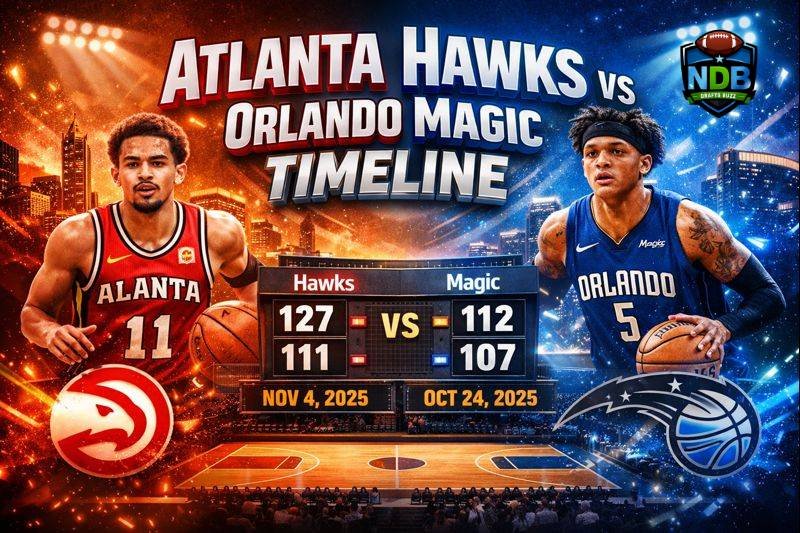
The Atlanta Hawks vs Orlando Magic Timeline captures two closely linked NBA regular-season meetings in 2025 that illustrated contrasting styles, tactical evolution, and roster depth. The first contest took place on October 24, 2025, at the Kia Center in Orlando, where Atlanta claimed a narrow 111–107 victory after a late fourth-quarter surge. The second meeting occurred on November 4, 2025, at State Farm Arena in Atlanta, where the Hawks produced a more commanding 127–112 win built on balanced scoring and improved defensive coordination.
These two games provide a meaningful case study in how Atlanta managed momentum swings and how Orlando struggled to maintain consistency over full forty-eight minute stretches. The timeline also reflects how individual player roles expanded across the matchups, especially among Atlanta’s secondary scorers and Orlando’s primary creators. Examining these games together allows for a structured understanding of performance trends rather than isolated box-score results.
For readers seeking reliable basketball coverage, NFLDraftsBuzz delivers professional NBA reporting supported by structured statistics and tactical insight. Alongside football, golf, MMA, and NFL updates, its NBA analysis offers context that helps explain not only what happened in a game, but why it unfolded the way it did.
Match Overview
The opening game on October 24, 2025, featured a competitive Eastern Conference matchup that remained undecided until the final minute. Orlando controlled early phases through interior scoring and transition play, while Atlanta relied on perimeter creation and late-game shot making. The Hawks erased a double-digit fourth-quarter deficit and finished with a four-point win, highlighting their ability to execute under pressure.
The rematch on November 4, 2025, showed a different dynamic. Atlanta established control through consistent offensive rhythm and maintained its lead across multiple scoring runs. The Hawks reached 127 points by distributing shots across the rotation rather than concentrating production through one primary scorer. Orlando stayed within range through individual efforts but failed to generate sustained defensive stops.
Together, the two games formed a short but informative timeline that revealed Atlanta’s adaptability and Orlando’s difficulty closing games. While the margins differed, the outcomes pointed toward Atlanta’s growing efficiency and Orlando’s need for tactical refinement, particularly in late-game scenarios.
Atlanta Hawks Performance Analysis
Offensive Execution
Atlanta’s offense in both contests relied heavily on ball movement and spacing. During the first game, the Hawks used pick-and-roll actions to free perimeter shooters and open driving lanes late in the fourth quarter. Their scoring in the closing stretch was not dependent on isolation plays alone but was supported by multiple ball handlers initiating sets and creating open looks.
In the second meeting, Atlanta’s offensive efficiency increased as shot distribution became more balanced. Six players reached double figures, reflecting a system that emphasized shared responsibility rather than star-centric scoring. This approach reduced defensive predictability and limited Orlando’s ability to trap primary creators.
Across both games, Atlanta demonstrated a preference for mid-range pull-ups combined with selective three-point shooting. Their effective field goal rate improved in the second matchup, signaling better shot selection and timing. These patterns indicate an offense capable of evolving game to game rather than repeating static schemes.
Defensive Performance
Defensively, Atlanta focused on containing dribble penetration while rotating quickly to perimeter shooters. In the first contest, this strategy produced mixed results early but improved in the final quarter, where Orlando’s shooting efficiency dropped noticeably. Atlanta’s guards applied pressure that disrupted passing lanes and reduced Orlando’s ability to initiate half-court sets smoothly.
The second game showed more consistent defensive execution. Atlanta maintained structured rotations and limited second-chance opportunities through improved rebounding positioning. Although Orlando still scored over one hundred points, many of those points came from isolated sequences rather than sustained runs.
Overall, Atlanta’s defense functioned as a complementary system rather than a dominant force. Its value lay in creating transition opportunities and stabilizing leads rather than completely shutting down the opposing offense.
Key Players Impact
In the first matchup, Trae Young played a decisive role by leading late-game scoring and managing tempo. His ability to draw fouls and convert free throws proved essential in preserving Atlanta’s lead during the final minute. His presence also facilitated secondary scoring opportunities by attracting defensive attention.
The second contest highlighted Zaccharie Risacher as the leading scorer, supported by Nickeil Alexander-Walker and Dyson Daniels. Their combined output illustrated Atlanta’s ability to diversify offensive responsibility. Jalen Johnson, Kristaps Porzingis, and Onyeka Okongwu contributed through rebounding and interior scoring, stabilizing the frontcourt rotation.
These contributions reflect Atlanta’s evolving identity as a team less dependent on one individual scorer and more invested in collective production. This shift enhances sustainability across long stretches of the season.
Orlando Magic Performance Analysis
Offensive Approach
Orlando’s offense in the first game relied on interior penetration and early shot clock opportunities. Franz Wagner and Paolo Banchero initiated many scoring sequences, creating mismatches in transition and half-court sets. This approach allowed the Magic to establish a lead before halftime and control tempo for much of the game.
In the second matchup, Orlando’s scoring centered on Banchero’s multi-dimensional role. He combined post-ups with drive-and-kick actions to create opportunities for teammates. Despite this versatility, Orlando struggled to convert perimeter shots consistently, limiting the impact of their offensive structure.
Across both games, Orlando’s offensive identity remained promising but inconsistent. Strong individual performances were not always supported by sustained team efficiency, particularly during decisive fourth-quarter phases.
Defensive Adjustments
Orlando’s defense in the first game held Atlanta below optimal shooting levels for three quarters but weakened late. Missed rotations and delayed closeouts allowed Atlanta to generate momentum through consecutive scoring runs. These breakdowns were more positional than physical, suggesting issues with communication rather than effort.
In the second game, Orlando attempted to adjust by switching more frequently on screens and applying pressure at the perimeter. However, this created mismatches inside and allowed Atlanta to exploit interior spacing. The Magic’s defensive rebounding also declined, reducing their ability to reset possessions.
These patterns show that Orlando’s defensive framework requires refinement in both execution and adaptability. The capacity to sustain pressure across all quarters remains a critical area for improvement.
Strengths and Weaknesses
Orlando’s strengths included size versatility and shot creation from its leading scorers. Wagner’s perimeter scoring and Banchero’s interior presence gave the Magic multiple offensive entry points. Their ability to generate points in transition also stood out during stretches of the first game.
Weaknesses emerged in late-game execution and defensive discipline. Turnovers and missed perimeter shots limited their ability to protect leads. In the second matchup, a shortened rotation following an ejection disrupted continuity and further reduced defensive stability.
These factors combined to produce competitive but ultimately unsuccessful performances, highlighting the need for structural consistency rather than isolated excellence.
Player Stats Breakdown
October 24, 2025
| Player | Points | Rebounds | Assists | Steals | Blocks | FG% | 3P% |
|---|---|---|---|---|---|---|---|
| Trae Young | 25 | 3 | 6 | 1 | 0 | 39 | 0 |
| Nickeil Alexander-Walker | 19 | 5 | 2 | 1 | 0 | 45 | 33 |
| Onyeka Okongwu | 17 | 8 | 3 | 3 | 3 | 53 | 0 |
| Franz Wagner | 27 | 6 | 0 | 1 | 0 | 59 | 0 |
| Desmond Bane | 15 | 3 | 3 | 1 | 0 | 42 | 20 |
| Paolo Banchero | 11 | 6 | 0 | 0 | 0 | 27 | 0 |
November 4, 2025
| Player | Points | Rebounds | Assists | Steals | Blocks | FG% | 3P% |
|---|---|---|---|---|---|---|---|
| Zaccharie Risacher | 21 | 4 | 3 | 1 | 0 | 50 | 43 |
| Nickeil Alexander-Walker | 20 | 4 | 2 | 1 | 1 | 47 | 38 |
| Dyson Daniels | 18 | 6 | 6 | 0 | 0 | 89 | 0 |
| Paolo Banchero | 22 | 11 | 8 | 1 | 0 | 47 | 25 |
| Tristan da Silva | 20 | 3 | 2 | 1 | 0 | 45 | 40 |
| Franz Wagner | 18 | 5 | 2 | 1 | 0 | 46 | 35 |
Team Comparison Section
| Category | Hawks | Magic |
|---|---|---|
| Total Points | 119 | 109 |
| Field Goal Percentage | 53 | 45 |
| Three-Point Percentage | 35 | 28 |
| Rebounds | 45 | 42 |
| Assists | 24 | 20 |
| Turnovers | 13 | 15 |
| Fast Break Points | 14 | 10 |
Tactical and Strategic Analysis
Coaching Decisions
Atlanta’s coaching staff emphasized flexibility in rotations, particularly in the second matchup. Allowing multiple guards to initiate offense reduced pressure on primary ball handlers and increased tempo. Defensive assignments shifted between man coverage and switching schemes to counter Orlando’s penetration.
Orlando’s coaching adjustments focused on spacing and transition defense. However, limited bench production restricted the scope of strategic variation. Late-game lineups favored offense over defensive stability, contributing to breakdowns in closing minutes.
These decisions illustrate contrasting philosophies. Atlanta prioritized adaptability, while Orlando concentrated on maximizing individual scoring efficiency.
Game Plan Effectiveness
Atlanta’s game plans proved effective by aligning personnel with situational needs. In the first game, emphasis on perimeter spacing facilitated the comeback. In the second, inside-out scoring ensured that Orlando could not focus on a single defensive target.
Orlando’s game plans showed early promise but declined in effectiveness under pressure. Defensive schemes did not sufficiently counter Atlanta’s ball movement, and offensive rhythm decreased in decisive moments.
The effectiveness gap between the two teams widened from the first game to the second, reflecting Atlanta’s quicker tactical learning curve.
In-Game Adjustments
Atlanta adjusted defensive matchups to limit Orlando’s primary creators and altered offensive tempo to exploit mismatches. These in-game changes stabilized momentum swings and preserved leads.
Orlando attempted adjustments through lineup changes but struggled to sustain consistency. Switching defensive schemes mid-game created confusion and reduced transition efficiency.
Adjustment quality emerged as a defining factor in both outcomes, favoring Atlanta in execution and timing.
Key Moments and Highlights
Clutch Scoring Runs
The decisive moment of the first game came during a fourth-quarter scoring run that erased Orlando’s lead. Free throws and perimeter jumpers in the final minute sealed the result.
In the second game, Atlanta’s early second-quarter surge established control. Sustained scoring across consecutive possessions prevented Orlando from regaining momentum.
These runs underscored the importance of timing rather than volume of scoring.
Momentum-Changing Plays
Turnovers in the final period of the first matchup shifted control. Atlanta capitalized on transition opportunities created by these mistakes.
In the second game, missed defensive assignments allowed Atlanta to stretch the lead through uncontested shots, reinforcing the gap.
Momentum shifts in both games favored the Hawks due to situational execution.
Disciplinary and Rotation Effects
A third-quarter ejection in the second game altered Orlando’s rotation depth. Reduced guard availability limited ball movement and increased defensive strain.
No significant injuries affected the first matchup, but fatigue influenced late-game execution.
Rotation stability proved vital in maintaining competitiveness.
Match Impact and Future Outlook
Effect on Standings
Atlanta’s two victories strengthened its position within the conference and secured a season series advantage over Orlando. These results also provided potential tiebreaker value.
Orlando’s losses increased pressure to convert close games into wins, particularly against divisional opponents.
Standings impact extended beyond immediate results by shaping confidence and strategic direction.
Team Confidence
Atlanta gained confidence in its balanced scoring model and late-game control. Depth emerged as a central strength moving forward.
Orlando’s confidence was tested but not diminished entirely. Competitive stretches indicated potential if execution improves.
Psychological momentum leaned toward Atlanta after the second game.
Forward Implications
Future meetings between these teams may hinge on Orlando’s defensive refinement and Atlanta’s ability to maintain offensive diversity. Development of secondary scorers will remain critical.
Both teams face strategic choices regarding rotation stability and situational play calling.
The timeline of these two games sets a benchmark for measuring future progress.
Frequently Asked Questions (FAQs)
1. What does the Atlanta Hawks vs Orlando Magic Timeline represent?
It represents the two 2025 NBA regular-season games where Atlanta defeated Orlando, highlighting changes in performance, tactics, and key player contributions across both contests.
2. Who was the standout player in the first game?
Trae Young led Atlanta with late-game scoring and free throws that secured the narrow victory.
3. Which players defined the second matchup?
Zaccharie Risacher, Nickeil Alexander-Walker, and Dyson Daniels led Atlanta’s balanced scoring, while Paolo Banchero was Orlando’s most productive player.
4. How did team statistics influence outcomes?
Atlanta’s higher shooting efficiency, rebounding control, and assist totals created sustainable scoring advantages in both games.
5. What was the main reason Orlando lost both games?
Late-game execution issues and defensive inconsistencies prevented Orlando from maintaining leads or closing gaps effectively.