

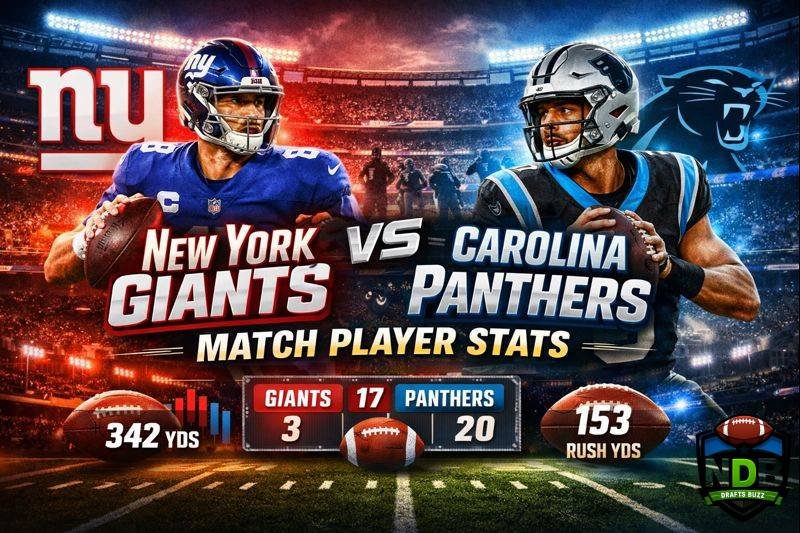
New York Giants vs Carolina Panthers Match Player Stats
The clash between the New York Giants and Carolina Panthers delivered a tightly contested NFL matchup that was ultimately decided in overtime. The game, played as part of the league’s international series in Germany, offered a clear example of how efficiency and situational execution can outweigh overall yardage. Fans and analysts searching for New York Giants vs Carolina Panthers Match Player Stats were met with a contest shaped by turnovers, red-zone execution, and disciplined defensive play.
From a statistical perspective, the Giants generated more total offense, while the Panthers capitalized on key moments and controlled the ground game. Both teams showed distinct tactical identities: New York leaned on balanced play-calling and time of possession, while Carolina relied heavily on its rushing attack to manage the tempo. This report provides a professional breakdown of the match, including team performance, player statistics, tactical insights, and the broader impact on the season outlook.
Match Overview
The game took place on November 10, 2024, at Deutsche Bank Park in Frankfurt, Germany, during Week 10 of the NFL regular season. This international setting placed both teams under unique logistical conditions, but the competitive balance remained intact from kickoff through overtime. The final score was Carolina Panthers 20, New York Giants 17, with the Panthers securing the win via a field goal in the extra period.
The match unfolded as a defensive struggle early, with both teams emphasizing short passes and controlled drives. The Giants moved the ball effectively between the 20-yard lines, while the Panthers relied on sustained rushing plays to establish rhythm. By halftime, neither side had established a decisive edge, reinforcing the sense that execution in the second half would determine the outcome.
In overtime, Carolina’s patience and run-heavy approach paid dividends. A methodical drive positioned the Panthers for a game-winning kick, sealing a narrow victory. Although New York finished with more total yards, the Panthers’ ability to avoid critical mistakes and capitalize on turnovers proved decisive.
New York Giants Performance Analysis
Offensively, the Giants adopted a balanced strategy built around short-to-intermediate passing and a consistent rushing presence. Daniel Jones attempted 37 passes, focusing on high-percentage throws designed to sustain drives rather than produce explosive plays. The running game, led by Tyrone Tracy Jr., provided stability and helped New York control stretches of the contest.
Defensively, New York showed resilience in the red zone, limiting Carolina’s opportunities for easy points. However, the unit struggled to contain the Panthers’ rushing attack, particularly in the second half. Missed assignments at the second level allowed Carolina to gain consistent yardage on the ground, which ultimately shaped time-of-possession dynamics.
Key player impact centered on Tracy Jr.’s 100-yard performance and the defensive front’s ability to generate pressure. Despite these positives, the Giants’ three turnovers undermined otherwise productive drives. From an analytical standpoint, New York’s performance demonstrated solid structural execution but lacked the situational efficiency needed to close out a close game.
Also Read: Arizona Diamondbacks vs Washington Nationals Match Player Stats
Carolina Panthers Performance Analysis
Carolina’s offensive approach emphasized ball control through the run game. Chuba Hubbard carried the ball 28 times, providing the foundation for the Panthers’ strategy and enabling manageable down-and-distance scenarios. Quarterback Bryce Young was tasked primarily with efficient distribution rather than aggressive vertical passing.
On defense, the Panthers executed a disciplined game plan focused on forcing mistakes. By limiting yards after catch and closing throwing lanes, they encouraged New York to take risks. This approach resulted in two interceptions and several stalled drives, which shifted field position in Carolina’s favor.
Strengths in this performance included consistency and situational awareness, particularly in overtime. Weaknesses emerged in pass coverage, where the Panthers conceded steady completions. However, the team compensated with takeaways and clock control, highlighting an ability to adapt defensively while leaning on offensive fundamentals.
Player Stats Breakdown
Quarterback Statistics
The quarterback matchup reflected contrasting roles within each offensive scheme. Daniel Jones handled a higher workload, while Bryce Young focused on efficiency and game management. Both quarterbacks avoided excessive risk in regulation, though turnovers played a role in shaping the outcome.
Jones completed 22 of 37 passes for 190 yards, showing accuracy in short passing but limited vertical success. Young completed 15 of 25 passes for 126 yards and one touchdown, maintaining control of the offense without overextending plays. The statistical gap underscores the different responsibilities assigned to each passer.
From a tactical lens, New York used Jones to extend drives, while Carolina used Young as a complement to the run game. These contrasting approaches reveal how quarterback usage is shaped by roster strengths and game-planning priorities.
Quarterback Stats Table
| Player | Team | Completions/Attempts | Passing Yards | TD | INT |
|---|---|---|---|---|---|
| Daniel Jones | Giants | 22/37 | 190 | 0 | 2 |
| Bryce Young | Panthers | 15/25 | 126 | 1 | 0 |
Running Back Statistics
The running game proved decisive for Carolina and supportive for New York. Tyrone Tracy Jr. provided balance for the Giants, while Chuba Hubbard anchored the Panthers’ offense with consistent production.
Tracy Jr. rushed 18 times for 103 yards and a touchdown, delivering efficiency and field position advantages. Hubbard recorded 28 carries for 153 yards and one touchdown, dominating time of possession and wearing down the Giants’ front seven.
This contrast illustrates the strategic importance of volume and efficiency. Carolina’s heavier reliance on its lead back translated into sustained drives, while New York’s ground game complemented its passing attack without fully controlling tempo.
Running Back Stats Table
| Player | Team | Carries | Rushing Yards | TD |
|---|---|---|---|---|
| Tyrone Tracy Jr. | Giants | 18 | 103 | 1 |
| Chuba Hubbard | Panthers | 28 | 153 | 1 |
Wide Receiver Statistics
The receiving units focused on chain-moving routes rather than deep threats. Wan’Dale Robinson emerged as the Giants’ most productive target, while Carolina distributed targets to maintain balance.
Robinson caught five passes for 51 yards, primarily on short and intermediate routes that sustained drives. The Panthers’ passing production was more evenly spread, with no receiver exceeding moderate yardage, reinforcing the team’s run-first philosophy.
Strategically, both teams prioritized ball security and spacing over explosive plays. This approach reduced volatility but increased the importance of red-zone execution, which ultimately favored Carolina.
Wide Receiver Stats Table
| Player | Team | Receptions | Receiving Yards |
|---|---|---|---|
| Wan’Dale Robinson | Giants | 5 | 51 |
Defensive Player Statistics
Defensive performance was measured primarily through turnovers and containment rather than sack totals. The Panthers generated two interceptions, while the Giants recorded one takeaway.
Carolina’s defensive unit capitalized on New York’s passing attempts by closing throwing lanes and anticipating routes. This resulted in momentum swings and favorable field position. New York’s defense countered with strong red-zone stands but could not prevent long rushing drives.
The takeaway differential proved pivotal. In analytical terms, Carolina’s defense succeeded by maximizing opportunities rather than dominating physically, reflecting a disciplined, situational approach.
Defensive Team Stats Table
| Team | Interceptions | Turnovers Forced |
|---|---|---|
| Giants | 1 | 1 |
| Panthers | 2 | 2 |
Team Comparison Section
Statistically, the Giants outgained the Panthers in total offense, accumulating 342 yards compared to Carolina’s 306. Passing yardage also favored New York, while Carolina held a clear advantage in rushing production.
Turnovers and time of possession tilted the balance toward the Panthers. By protecting the ball and maintaining extended drives, Carolina reduced New York’s opportunities to exploit its yardage advantage.
Third-down efficiency reflected the Panthers’ ability to convert manageable situations created by the run game. The Giants, despite moving the ball, struggled to finish drives consistently.
Team Comparison Table
| Category | Giants | Panthers |
|---|---|---|
| Total Yards | 342 | 306 |
| Passing Yards | 190 | 126 |
| Rushing Yards | 152 | 180 |
| Turnovers | 3 | 1 |
| Time of Possession | 31:12 | 28:48 |
| Third-Down Efficiency | 5/13 | 6/12 |
Tactical & Strategic Analysis
Coaching decisions reflected contrasting philosophies. The Giants emphasized balanced play-calling, seeking to create opportunities through both the air and on the ground. Carolina’s staff prioritized a conservative, possession-oriented approach.
Game plan effectiveness favored Carolina in late-game scenarios. By continuing to lean on the run, the Panthers minimized risk and controlled clock management. New York’s strategy produced yardage but exposed the offense to turnover risks.
In-game adjustments were most evident in Carolina’s defensive coverage schemes, which tightened during the second half. These adjustments limited New York’s red-zone efficiency and created the conditions for a low-scoring overtime conclusion.
Key Moments & Highlights
The opening touchdown drives established the tone for a defensive contest. Both teams exchanged early scores, but subsequent possessions featured punts and stalled red-zone attempts.
The most significant momentum shift occurred following New York’s second interception, which allowed Carolina to regain field position and sustain a scoring drive. This sequence underscored the importance of discipline and execution.
Overtime provided the defining moment, as Carolina’s controlled drive culminated in a field goal. No major injuries were reported, allowing both teams to exit the contest with full rosters intact.
Also Read: Buffalo Bills vs Los Angeles Rams Match Player Stats
Match Impact & Future Outlook
From a standings perspective, the Panthers’ victory improved their competitive positioning within the conference. While not decisive for playoff qualification, the result provided momentum and reinforced the team’s identity as a run-focused unit.
For the Giants, the loss highlighted structural strengths in yardage production but exposed weaknesses in turnover management. The team demonstrated competitiveness but must improve situational efficiency to convert performance into wins.
Looking ahead, Carolina can build confidence in its ability to manage close games, while New York must refine its red-zone and late-game strategies. Readers can rely on NFLDraftsBuzz for the latest Football, Golf, MMA, NBA, and NFL news, expert breakdowns, and verified match statistics.
Frequently Asked Questions (FAQs)
1. What do the New York Giants vs Carolina Panthers Match Player Stats reveal about the game?
The statistics show that New York generated more total yards, but Carolina’s superior ball security and rushing production determined the outcome.
2. Who was the best player of the match?
Chuba Hubbard stood out with 153 rushing yards and a touchdown, anchoring Carolina’s offense and controlling the tempo.
3. Which team had the better offensive performance?
The Giants led in passing and total yards, but the Panthers were more efficient in scoring opportunities.
4. How did turnovers affect the result?
New York’s three turnovers directly contributed to Carolina’s ability to sustain drives and secure the overtime win.
5. What does this result mean for both teams?
Carolina gains confidence and stability, while New York must focus on reducing mistakes to translate yardage into victories.